Shopping Cart (0)
Close


24 Hours

+83 178 5718 5371

Yiwu Lei Ji, Trading Co., Ltd Unit 1749, 17th Floor, El Oriente Tower, Yiwu City, China
No products in the cart.

No products in the cart.
Incoterms are simply trade rules that help buyers and sellers avoid confusion. They don’t decide the price, but they set the rules for transport, insurance, customs, and delivery responsibility. That sounds dry, but in real life, it can be the difference between a smooth shipment and a very expensive headache.
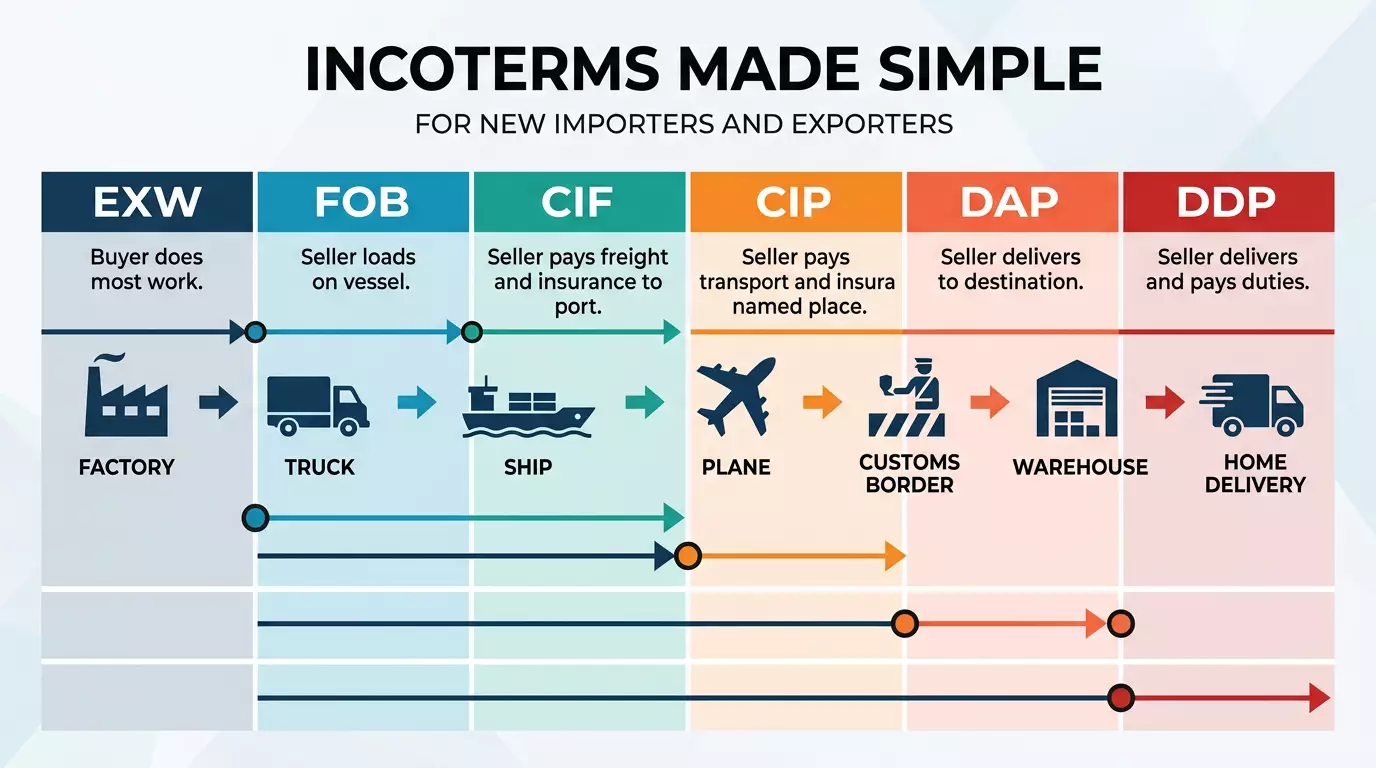
| Term | Seller responsibility | Buyer responsibility | Best for |
|---|---|---|---|
| EXW | Makes goods available at factory | Almost everything else | Buyers with strong logistics support |
| FOB | Gets goods loaded on vessel | Freight, insurance, import clearance | Ocean freight buyers |
| CIF | Pays freight + insurance to port | Import clearance, duties, inland delivery | Buyers importing by sea |
| CIP | Pays transport + insurance to named place | Import clearance, duties | Air or multimodal shipments |
| DAP | Delivers to destination | Import duties & taxes | Door delivery but handle customs |
| DDP | Delivers + pays duties/taxes | Receives goods | Buyers who want simplest experience |
Risk changes hands at different milestones: FOB at vessel loading, CIF at destination port, DAP at final delivery point.
EXW — if you already have a freight forwarder and want full control. Cheap on paper, but messy if you’re inexperienced.
FOB — ideal for sea freight, classic split: seller loads, buyer arranges main carriage. Clear line of risk transfer.
CIF — seller covers freight and insurance to the destination port. You still handle import duties & inland transport.
CIP — works for air or multimodal transport + insurance. Good for valuable cargo across mixed routes.
DAP — goods delivered near your door, but you manage customs clearance & taxes. Balance of convenience & control.
DDP — simplest for the buyer: seller handles everything, including duties. Preferred by e‑commerce and smaller importers, though sellers may find it heavy on paperwork.
*Insurance under DAP is not mandatory by default, but seller may arrange; under DDP seller typically covers risk fully.
Trade terms aren’t just shipping alphabet soup. They decide who does the work, who carries the risk, and who pays when things go wrong. For new importers in Southern Africa and beyond, the safest move is to align the Incoterm with your experience level, route, and customs setup.
Before you sign any deal, ask one simple question:
Who pays, who clears, and who carries the risk?

We understand you may have questions .To help along your buying journey we compile answers to the most common queries.
Yiwu Machines specializes in sourcing high-quality machinery from China and providing end-to-end logistics solutions, including LCL (groupage) and FCL shipping, supplier coordination, and cargo handling
LCL shipping allows you to ship smaller volumes of cargo without booking a full container. Your goods are consolidated with other shipments, helping you save on shipping costs while maintaining flexibility.
Yes, we provide Full Container Load (FCL) shipping for customers with larger cargo volumes. FCL shipments offer faster transit times and added security for bulk orders.
We provide up to 20% free CBM space on every shipment. Once your accumulated free space reaches 1 CBM, you can use it on future shipments at no extra cost. FCL customers also receive 3 CBM credit for LCL on their next shipment. Terms and conditions apply.
Shipping is handled by Yiwu Shipping, our in-house logistics division under Yiwu Leso Group, ensuring better coordination, accurate scheduling, and reliable delivery.
We work with vetted and trusted Chinese suppliers who meet strict quality standards. We can also assist with inspections before shipment to ensure your order meets your expectations.
Yes, we provide shipment tracking and regular updates so you can monitor your cargo throughout the shipping process.
We accept multiple payment options, including bank transfers, credit/debit cards, and other secure payment methods depending on your location.
Yes, we provide guidance and support with shipping documentation and customs processes to help ensure smooth clearance at your destination.Customers are responsible for taxes imposed.
Shipping times vary depending on the destination and shipping method (LCL or FCL) 8-19days my Air Cargo and 45 days maximum by Sea Cargo, and we prioritize precise scheduling and timely delivery through our integrated logistics system.