Shopping Cart (0)
Close


24 Hours

+83 178 5718 5371

Yiwu Lei Ji, Trading Co., Ltd Unit 1749, 17th Floor, El Oriente Tower, Yiwu City, China
No products in the cart.

No products in the cart.
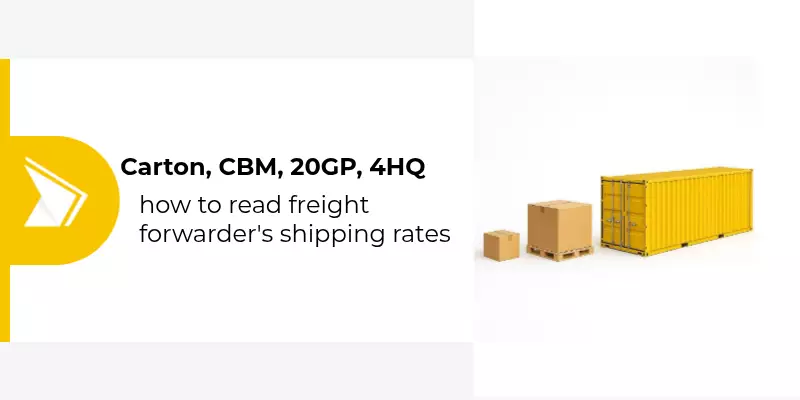
Reading a freight forwarder’s shipping rates can feel overwhelming at first. You see terms like CBM, cartons, 20GP, and 40HQ, and it looks like a secret code. But underneath all the jargon, it’s really about one simple idea: how much space your goods take up, and whether you’re paying for shared space or a full container.
Once you understand this, comparing quotes becomes much easier—and you’ll stop overpaying for space you don’t need.
CBM stands for cubic meter. It’s the standard way to measure volume in sea freight—not weight.
When someone says “one carton, one CBM,” they’re using a simplified estimate to say: one box takes up about one cubic meter of space. In reality, cartons can be smaller or larger, but this rule of thumb helps buyers and forwarders quickly calculate space.
Why CBM matters:
Freight pricing generally falls into two categories:
Use LCL when your shipment doesn’t fill a whole container. Your goods are combined with other importers’ cargo, and you pay per cubic meter.
How it works:
Pros:
Cons:
Use FCL when your shipment is big enough to justify booking a whole container. You pay a flat rate for the entire container, whether it’s 100% full or only 80% full.
Common container types:
How it works:
Pros:
Cons:
| Shipment Size | Best Option | Why |
|---|---|---|
| 1–10 CBM | LCL | Cheaper to pay per CBM than rent a whole container. |
| 10–15 CBM | Borderline | Compare LCL total vs. 20GP flat rate. |
| 15+ CBM | FCL (20GP) | Full container often cheaper than per-CBM fees. |
| 35+ CBM | FCL (40HQ) | Maximize space; 40HQ offers more volume. |
Pro tip: Even if your container isn’t 100% full, FCL can still be cheaper than LCL once you factor in consolidation fees and handling charges.
When you get a quotation, don’t just look at the final number. Break it down:
Some quotes cover only port-to-port ocean freight. Others include:
Two quotes might look similar, but the coverage can be very different.
Watch out for:
Forwarders compare:
They charge for whichever is higher. This ensures bulky but light goods (like foam or pillows) are priced fairly.
Accurate measurements of your cartons and smart packaging can significantly reduce your final cost.
| Term | What It Means | Why It Matters |
|---|---|---|
| CBM | Cubic meter (volume) | Determines LCL pricing and space needed. |
| Carton | Individual box | Count and size help calculate total CBM. |
| 20GP | 20-foot standard container | Holds ~28–33 CBM; flat rate for FCL. |
| 40HQ | 40-foot high cube container | Holds ~68–76 CBM; extra height for tall cargo. |
| LCL | Less than Container Load | Pay per CBM; shared space. |
| FCL | Full Container Load | Pay flat rate; entire container. |
Each of these can cost you more than you save on the headline rate.
Freight forwarder rates stop being intimidating once you understand the system:
The rate you get is simply the method used to charge for shared space or a full container. Once you see it this way, comparing quotes becomes less about guessing and more about understanding exactly what you’re paying for.
Talk to a freight specialist before booking your shipment. Get a full breakdown, verify what’s included, and choose the option that matches your cargo size—not just the lowest headline price.

We understand you may have questions .To help along your buying journey we compile answers to the most common queries.
Yiwu Machines specializes in sourcing high-quality machinery from China and providing end-to-end logistics solutions, including LCL (groupage) and FCL shipping, supplier coordination, and cargo handling
LCL shipping allows you to ship smaller volumes of cargo without booking a full container. Your goods are consolidated with other shipments, helping you save on shipping costs while maintaining flexibility.
Yes, we provide Full Container Load (FCL) shipping for customers with larger cargo volumes. FCL shipments offer faster transit times and added security for bulk orders.
We provide up to 20% free CBM space on every shipment. Once your accumulated free space reaches 1 CBM, you can use it on future shipments at no extra cost. FCL customers also receive 3 CBM credit for LCL on their next shipment. Terms and conditions apply.
Shipping is handled by Yiwu Shipping, our in-house logistics division under Yiwu Leso Group, ensuring better coordination, accurate scheduling, and reliable delivery.
We work with vetted and trusted Chinese suppliers who meet strict quality standards. We can also assist with inspections before shipment to ensure your order meets your expectations.
Yes, we provide shipment tracking and regular updates so you can monitor your cargo throughout the shipping process.
We accept multiple payment options, including bank transfers, credit/debit cards, and other secure payment methods depending on your location.
Yes, we provide guidance and support with shipping documentation and customs processes to help ensure smooth clearance at your destination.Customers are responsible for taxes imposed.
Shipping times vary depending on the destination and shipping method (LCL or FCL) 8-19days my Air Cargo and 45 days maximum by Sea Cargo, and we prioritize precise scheduling and timely delivery through our integrated logistics system.
![Yiwu Machines Logo - Red [Recovered]-01](https://yiwumachines.com/wp-content/uploads/2026/03/Yiwu-Machines-Logo-Red-Recovered-01.png "Yiwu Machines Logo - Red [Recovered]-01")